Introduction
1. Faith Community Church is committed to providing a child-safe and child-friendly environment, which includes ensuring that children, personnel, or families who wish to report allegations of abuse or child safety concerns know how to report abuse allegations and are encouraged to do so.
2. Abuse often occurs in environments where trust is involved, where a person in a position of trust and/or authority misuses their position to harm another. Often the recipient of the abuse is vulnerable due to their personal circumstances or because the abuser exerts a position of power or authority. Abuse is a serious concern, and it is the responsibility of leaders within Faith Community Church and all those who work with children to do everything possible to prevent and/or minimise the risk of abuse.
3. Faith Community Church adopts the ChildSafe Safety Management System and is committed to sound implementation of it. This policy is intended to help Faith Community Church achieve this.
4. This policy must be followed by every person involved in Faith Community Church.
5. For the purpose of this policy a child is a person under the age of 18 years.
Making Complaints
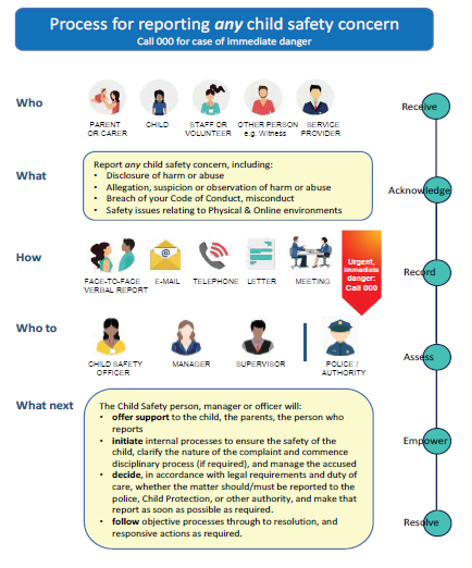
6. Any child, parent, child’s trusted adult representative, independent support person, staff member, volunteer or adult survivor may make a complaint about abuse or inappropriate behaviour undertaken by any person involved in Faith Community Church.
7. Abuse can involve neglect, emotional abuse, physical abuse, sexual abuse, domestic violence, and bullying.
8. Inappropriate behaviour (that can be sexual in nature) includes but is not limited to:
a) showing favours to one child over others (for example, providing special tutoring to a child or giving a child a lift home)
b) baby sitting
c) taking photos of a child who is in the care of Faith Community Church outside of official duties.
d) creating situations to be alone unsupervised with a child (for example, tutoring, rehearsals, excursions)
e) repeatedly visiting a child and/or their family at their home for no professional reason
f) providing gifts or favours to a child or their family
g) wearing inappropriate clothing around children
h) using sexual language or gestures
i) making written or verbal sexual advances
j) sharing sexual photos or videos or other photos of the child
k) sharing details with a child of one’s own sexual experiences.
l) taking a child to one’s house to be alone with the child.
m) arranging to meet a child alone away from the institution when there is no professional reason for doing so.
n) sharing phone numbers with a child.
o) engaging with a child via social media.
p) asking children to keep a relationship secret.
q) showering or dressing or undressing with the door open (for example, on excursions and in residential situations)
r) not respecting the privacy of children when they are using the bathroom or changing (for example, on excursions and in residential situations)
Note: While it is understood that actions a), b), c), e), f), n) and o) occur normally within the contexts of family and some pre-existing relationships, it remains the safety policy of the organisation not to engage in these ways, in the context of the organisation’s activity.
9. Below are examples of conduct, which if proven, would constitute a criminal offence:
a) obscene exposure (for example, an adult masturbating in front of a child or exposing their genitals)
b) having, attempting to have, or facilitating any kind of sexual contact with a child.
c) possessing, creating, or exposing children to pornography
d) giving goods, money, attention, or affection in exchange for sexual activities or images
e) voyeurism
f) sexting
g) grooming offences (as defined by law in most jurisdictions).
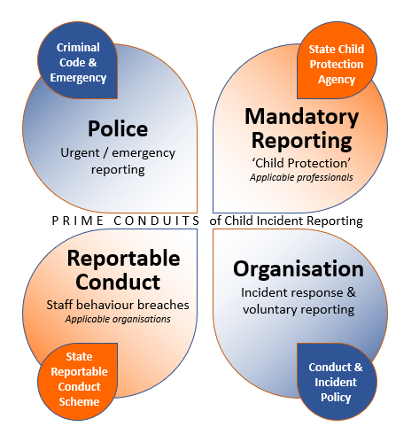
10. Inappropriate behaviour complaints, or complaints about abuse may realistically be disclosed to anyone in Faith Community Church. However, the ordinary reporting process is that complaints are made to a team leader, the coordinator, risk management officer, or an elder.
11. Complaints should ideally be made in writing, but this is not always possible. If a complaint is made verbally, the person to whom the complaints is made should record it in writing as soon as possible. Complainants should be encouraged to report their allegation to the Police where the conduct is criminal. Individuals should also be informed of their right to also complain to an independent body (such as the Child Protection Ombudsman).
Responding to Complaints
12. If a complaint is made by a child (and is not subject to Police processes), the most important thing is to listen and tell the child that they are not to blame. Do not press for information or push the child to reveal the details of the abuse. Do not ask leading questions, rather listen carefully and if possible, take notes. Reassure the child that they are right to tell and that what they say is taken very seriously, but do not promise them that no one else will be informed about the complaint.
13. Complaints may be made by someone who witnesses abuse towards a child or is informed about abuse that has allegedly occurred. These complaints should be taken just as seriously as if the complaint was coming from the child directly.
14. Faith Community Church should respond promptly and consistently to all complaints.
15. Members of Faith Community Church must be mindful of diversity and the cultural norms and expectations that are within the group of people coming into contact with Faith Community Church. It is important to be educated about the specific diversity needs within Faith Community Church. Additional safeguards may be required to meet the needs of children with disability, children from culturally and linguistically diverse backgrounds, Aboriginal and Torres Strait Islander children, or children who live in out-of-home care.
16. The response to the complaint should not just be about the factual circumstances of the allegation but should take into account the psychological and other effects on the complainant regardless of whether the complaint has at that stage been formally upheld. Prompt referral to trauma-based counselling including funding of such treatment should occur (where possible and not provided by government systems like the mental health plan for psychologists) to ensure that the potential damage to the victim is minimised.
Risk Assessments
17. Upon receiving a complaint of child sexual abuse, an initial risk assessment must be conducted to identify and minimise any risks to children. This should include:
a) assessing the safety of the complainant and other children
b) considering what action should be taken about the accused including supervision, removal of contact with children, being stood down and termination. If a complaint of child sexual abuse against a person within Faith Community Church is plausible, and there is a risk that person may come into contact with children in the course of their work, the person should be stood down from their position while the complaint is investigated.
c) considering whether it is necessary to report to another agency and if so, report to that agency, including the police and child protection authorities.
d) considering who, if anyone, should be informed of the complaint.
e) considering whether there are any restrictions to informing others, for example, whether the disclosure bypasses the Privacy Act by being required by law or not.
f) determining to implement the decisions made as a result of the risk assessment.
g) supporting those affected including the child or children involved (or the person who made the complaint).
Investigating Complaints
18. Faith Community Church must investigate all complaints of conduct that does not reach the criminal threshold but may be inappropriate and/or a breach of Faith Community Church’s Code of Conduct. If there is any doubt about whether the criminal threshold has been reached, the allegation should be reported to the relevant authorities.
19. The person investigating may be an employee of Faith Community Church, a contractor to it or independent of it, depending on the incident type and its gravity.
20. The investigator must ensure that they:
a) are impartial and objective, applying a consistent treatment of allegations regardless of who they come from and who they are against
b) have no conflict of interest with the proper investigation of the complaint.
c) have training, skills and experience in investigating child abuse
d) follow steps to meet the requirements of procedural fairness.
21. The Risk Management Officer should oversee the investigation. They must have sufficient authority to discharge the role effectively and be able to demonstrate they are impartial and objective.
Outcomes
22. All outcomes and decisions made must be accurately recorded, including the reasons for the decisions.
23. Faith Community Church shall consider how to put into effect any decisions, including informing the complainant and other interested people, institutions or other agencies.
24. Faith Community Church may consider the need to conduct a systemic review or root cause analysis, if necessary, and consider the need to recommend changes from that process outlining the continuous improvement system that is in place – including analysis of complaints to identify and address systemic issues.
External Bodies
25. Faith Community Church will report concerns, allegations and disclosures relating to children to external authorities, namely the Police and Child Protection or other relevant authority.
26. Members of Faith Community Church are always able to make a report directly to the Police or Child Protection before going through this complaint process. However, afterwards [insert position] must be notified of the report made, in order that Faith Community Church can take appropriate safety measures and support the parties involved.
27. If the Police are investigating or deciding whether to investigate an allegation, any communication undertaken by Faith Community Church might interfere with the Police investigation or undermine possible criminal proceedings. If Faith Community Church considers urgent action is required to protect the children in its care, it should consult the Police or Child Protection agency about the action. If Faith Community Church wishes to communicate with children, parents or staff about the matter, it should do so only in consultation with the Police or Child Protection agency.
Documentation
28. A complaints register shall be kept by the coordinator, which shall detail all complaints, information obtained, the action taken and findings.
29. All steps taken in the complaint handling process must be documented including:
a) receipt of the complaint
b) contact with the complainant
c) contact with witnesses
d) contact with the accused
30. Evidence obtained during the investigation, including witness statements, must be retained. The identity of the author of the record, the reason for their involvement and the date the record was made shall be documented.
31. Documents are to be kept secure in a complaints register which is contained in the ChildSafe Safety Management Online system. The Coordinator shall be responsible for safeguarding the documentation located on the Organisation’s site, and only the Coordinator and Risk Management Officer shall be permitted to access to them.
Follow Up
32. Faith Community Church should ensure that victims are looked out for even after a complaint is resolved as the effects of child abuse, especially sexual abuse, are lifelong. The practice of finalising a complaint and excluding someone from an organisational community should be avoided. At the same time Faith Community Church should not hold up the healing of the victim by remaining entangled with the victim in the long term.
Click here to download the Child Harm, Abuse & Complaints Policy
CHILD HARM, ABUSE & COMPLAINTS POLICY